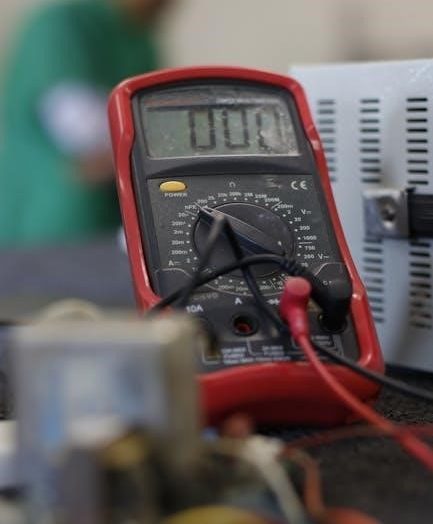
Simpson 260 Multimeter Manual: A Comprehensive Guide
This manual details the Simpson 260’s repair, diagnostics, and features, including power supply analysis and the indicator circuit’s components.
The Simpson 260 is a versatile analog multimeter renowned for its durability and accuracy, widely used by professionals and hobbyists alike. This manual serves as a comprehensive resource for understanding, operating, and maintaining this classic instrument. Its robust design and reliable performance have cemented its place in the field of electrical measurements for decades.
Originally designed for general-purpose electrical testing, the Simpson 260 excels in a broad range of applications, from basic circuit troubleshooting to more complex radio electronics measurements. The 260-6MRT variant, specifically, incorporates features tailored for semiconductor analysis, offering a low-ohm power range ideal for characterizing these components. Understanding its capabilities is crucial for maximizing its utility. This guide will delve into each aspect of the multimeter, ensuring users can confidently tackle various measurement tasks.
Historical Context and Usage
The Simpson 260’s lineage traces back to Simpson Electric Company’s long history of producing high-quality test equipment. Its design reflects a period where robust, analog instruments were the standard for electrical work. Early adoption spanned various industries, including radio repair, industrial maintenance, and educational institutions. The multimeter’s three scales – hours, minutes (0-60), and seconds (0-60) – demonstrate a unique feature found on some models.
Throughout its lifespan, the Simpson 260 has been a staple for technicians needing reliable measurements in the field. Its use extends to experimental setups, as documented in resources like kepstr.eltech.ru, showcasing its integration into academic and research environments. The 260’s continued relevance speaks to its enduring quality and the preference for analog readings among many professionals, even with the rise of digital multimeters.

Understanding the Simpson 260’s Features
The Simpson 260 offers voltage, current, and resistance measurements, alongside diode and continuity testing, making it versatile for diverse electrical applications.
Voltage Measurement Capabilities
The Simpson 260 excels in voltage measurement, providing accurate readings across a broad spectrum of DC and AC voltages. Its analog meter movement, coupled with a precise range selector switch, allows users to select the appropriate scale for optimal resolution. Understanding the input jacks is crucial; typically, a common terminal and a voltage input are utilized.
The multimeter’s design ensures reliable voltage measurements in various applications, from basic circuit troubleshooting to more complex electronic analysis. The 260’s ability to measure voltage accurately is fundamental to its functionality, enabling technicians and hobbyists to diagnose electrical issues effectively. Careful attention to range selection and proper probe placement are essential for obtaining precise and safe voltage readings. The instrument’s robust construction and quality components contribute to its long-term reliability in voltage measurement tasks.
Current Measurement Capabilities
The Simpson 260 provides robust current measurement capabilities, accommodating both DC and AC current within specified ranges. Utilizing the appropriate input jacks and range selector switch settings is paramount for accurate readings and to prevent damage to the instrument or the circuit under test. Current measurements often require breaking the circuit to insert the multimeter in series with the load.
Understanding the limitations of the meter’s current ranges is crucial; exceeding these limits can activate the internal overload protection. The analog meter movement displays the current value, and careful observation of the scale is necessary for precise readings. This multimeter’s current measurement functionality is essential for diagnosing power supply issues and evaluating circuit performance. Proper technique and adherence to safety precautions are vital when measuring current with the Simpson 260.
Resistance Measurement Capabilities
The Simpson 260 excels in resistance measurement, offering a variety of ranges to accommodate diverse component values. Accurate resistance readings require the component to be isolated from any active circuit, preventing interference from other circuit elements. Selecting the appropriate range on the range selector switch is critical; starting with the highest range and decreasing it ensures accurate measurement and protects the meter.
The analog meter movement displays the resistance value, and understanding the scale markings is essential for correct interpretation. The 260-6XLM variant features an exceptionally low ohms power range, specifically designed for sensitive semiconductor measurements. Proper technique and awareness of the meter’s limitations are vital for obtaining reliable resistance readings. This capability is fundamental for troubleshooting electronic circuits and verifying component functionality.
Diode Test Function
The Simpson 260’s diode test function is invaluable for assessing the functionality of diodes, transistors, and other semiconductor junctions. This test applies a small forward voltage across the component and measures the resulting forward voltage drop. A healthy diode will exhibit a forward voltage drop typically between 0.5V and 0.8V, while an open diode will show infinite resistance, and a shorted diode will display near-zero resistance.
This function aids in identifying faulty semiconductors within circuits. When testing, ensure the component is isolated to prevent inaccurate readings. The 260’s precision allows for reliable identification of diode failures. Understanding the expected forward voltage drop for different diode types is crucial for accurate assessment. This feature is essential for efficient troubleshooting and component verification in electronic repair.
Continuity Test Function
The Simpson 260’s continuity test function provides a quick and easy method for verifying electrical connections. When activated, the meter emits an audible tone if the resistance between the test leads is below a certain threshold, typically around 30-50 ohms. This function is incredibly useful for tracing wires, checking for broken connections, and confirming proper soldering joints.
Before using, ensure the circuit is de-energized to prevent damage to the meter or accidental shock. The continuity test is a fundamental step in troubleshooting electronic devices. It helps pinpoint breaks in circuits efficiently. Remember to disconnect components when testing to avoid false readings due to parallel paths. This feature significantly speeds up the diagnostic process, making it a vital tool for any electronics enthusiast or technician.

Detailed Component Breakdown
This section dissects the Simpson 260, examining the analog meter movement, range selector switch, input jacks, and internal fuse/protection circuitry.
The Analog Meter Movement
The Simpson 260 utilizes a highly sensitive, traditional analog meter movement as its core display component. This movement operates on the principle of electromagnetic deflection, where current flowing through a coil within a magnetic field generates a torque proportional to the current’s magnitude. This torque is balanced by a spring, resulting in a pointer deflection across a calibrated scale.
Understanding the meter’s construction is crucial for troubleshooting. The movement consists of a coil, a permanent magnet, a control spring, and a damping mechanism. The scale itself is carefully calibrated to represent various electrical units – volts, amperes, and ohms – depending on the selected range. Accuracy relies on the precision of the coil winding, magnet strength, and spring tension.
Damage to the meter movement, such as a broken coil or weakened spring, will result in inaccurate readings or a non-responsive display. Careful handling and avoiding excessive current are essential to preserve its functionality.
Range Selector Switch Explained
The range selector switch on the Simpson 260 is a critical component, dictating the measurement range and influencing the meter’s sensitivity. It achieves this by internally connecting different resistor networks, attenuating or amplifying the input signal before it reaches the meter movement. Proper understanding of its operation is vital for accurate readings.
Each position on the switch corresponds to a specific range for voltage, current, or resistance measurements. Selecting the appropriate range is crucial; too low a range can overload the meter, while too high a range reduces sensitivity. The switch’s internal contacts can become corroded or damaged over time, leading to inaccurate readings or intermittent functionality.

Careful observation of the switch’s action and cleaning of its contacts are essential maintenance procedures. A faulty range selector switch is a common source of problems in older Simpson 260 multimeters.
Input Jacks and Their Functions
The Simpson 260 utilizes several input jacks, each dedicated to specific measurement types and probe connections. Understanding their purpose is fundamental to correct operation. Typically, there are jacks for common (COM), voltage (V), and current (A). The common jack serves as the reference point for all measurements, connecting the negative side of the circuit under test.
The voltage jack is used for measuring DC and AC voltages, with separate terminals often provided for different voltage ranges. Current measurements utilize dedicated jacks, often differentiated for DC and AC current, and further subdivided by current range (e.g., milliamps, amps).
Incorrect jack selection can lead to inaccurate readings or even damage to the meter. Always double-check the jack configuration before making any measurement, ensuring the probes are securely connected.
Internal Fuse and Protection Circuitry
The Simpson 260 incorporates internal fuse protection to safeguard against overcurrent situations that could damage the sensitive meter movement and internal circuitry. This fuse is a critical component, and its condition directly impacts the meter’s reliability and safety. Regularly inspecting and replacing the fuse, when necessary, is essential maintenance.
Beyond the fuse, the 260 likely includes additional protection circuitry designed to limit the impact of voltage spikes or incorrect input connections. This circuitry aims to prevent damage to the analog movement and other components. However, these protective measures are not foolproof, and careful operation remains paramount.
Understanding the fuse rating and location is crucial for proper repair and maintenance, ensuring the correct replacement is used to maintain optimal protection.

Troubleshooting Common Issues
Addressing problems like no display, inaccurate readings, overload activation, or a faulty range selector switch ensures continued reliable operation of your Simpson 260.
No Display or Reading
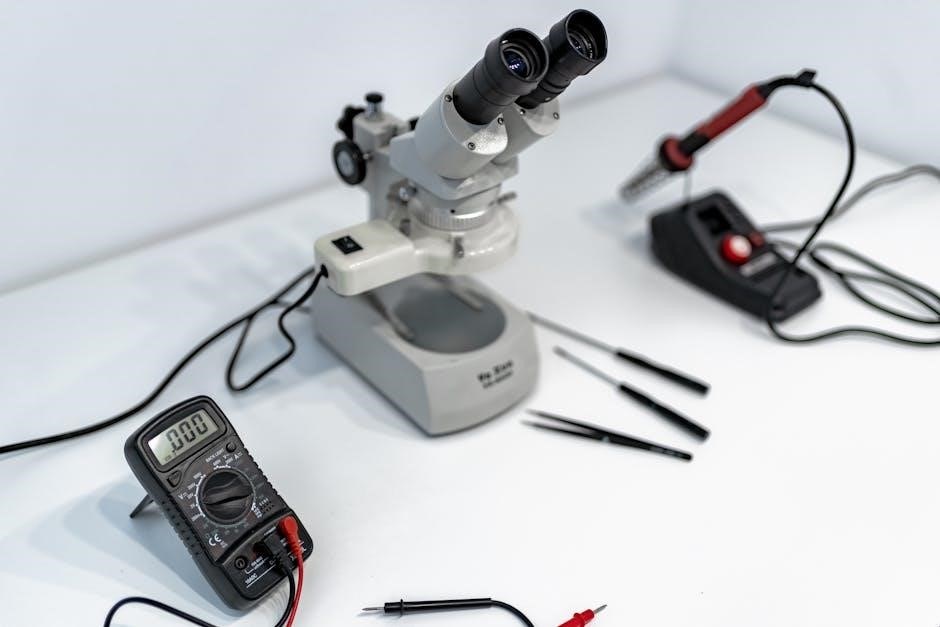
A complete lack of display or reading on the Simpson 260 often points to power supply issues. Begin by meticulously checking the internal fuse; a blown fuse is a common culprit and a simple fix. If the fuse is intact, proceed to diagnose the power source itself, verifying voltage levels are within acceptable parameters.
Further investigation should focus on the indicator circuit, specifically the LCD display, driver, decoder, and associated resistors. A failure within any of these components can prevent a reading. Inspect connections for looseness or corrosion. Consider that the indicator circuit displays the last known state, suggesting a potential issue with signal processing before reaching the display.
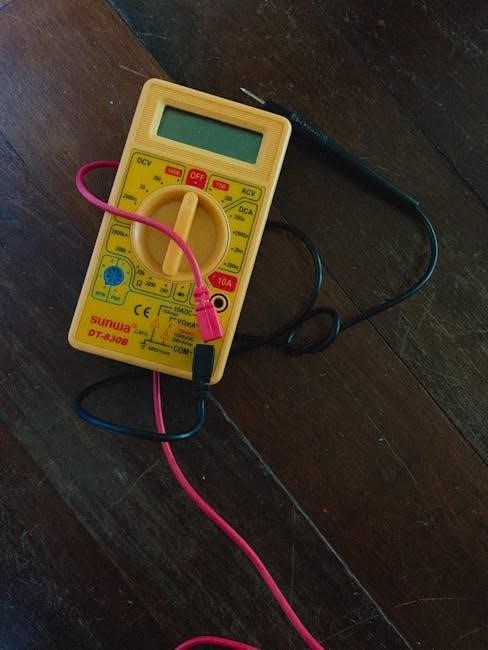
Remember to consult the schematic diagram (260-6MRT) for detailed component locations and testing points. A systematic approach, starting with the power supply and progressing through the indicator circuit, will efficiently pinpoint the source of the problem.
Inaccurate Readings
If the Simpson 260 provides readings that deviate significantly from expected values, several factors could be at play. Calibration drift is a primary suspect, especially with older analog instruments. Regular calibration, using known standards, is crucial for maintaining accuracy. Examine the analog meter movement itself for any physical damage or binding, as this directly impacts needle positioning.
The range selector switch should also be scrutinized; a faulty switch may not connect to the correct internal circuitry, leading to incorrect scaling. Verify the integrity of the internal resistors, as their values influence measurement precision. When measuring semiconductor parameters, ensure the appropriate range is selected for optimal results.
Consider external influences like temperature and humidity, which can subtly affect component values. A thorough inspection and, if necessary, component replacement are key to restoring accurate readings.
Overload Protection Activation
The Simpson 260 incorporates overload protection to prevent damage from excessive voltage or current. If activated, the meter may display no reading or an erratic one. This typically indicates a blown internal fuse, designed to sacrifice itself to safeguard sensitive components.
Before replacing the fuse, identify the cause of the overload – attempting to measure voltage beyond the meter’s limits or probing a circuit with excessive current are common culprits. Always use appropriately rated test leads and ensure correct range selection. Inspect the input jacks for any signs of physical damage or short circuits.
Replacing the fuse with one of the exact same rating is critical; using a higher-rated fuse defeats the protection mechanism. Following proper safety procedures is paramount when investigating overload events.
Faulty Range Selector Switch
A malfunctioning range selector switch is a frequent cause of inaccurate readings or a complete lack of display on the Simpson 260. This switch governs the internal circuitry, directing signals to the appropriate measurement ranges. Wear and tear, oxidation, or physical damage can disrupt its functionality.
Symptoms include intermittent readings, readings that don’t change with input signals, or the meter remaining stuck on a single range. Carefully inspect the switch for visible damage. Cleaning the switch contacts with a specialized contact cleaner may restore functionality, but this requires disassembly.
If cleaning fails, the switch may require replacement. This is a more complex repair, demanding soldering skills and a suitable replacement part. Incorrect range selection due to a faulty switch can also lead to overload conditions.

Repair and Maintenance
Essential maintenance includes fuse replacement, cleaning, and calibration; schematic diagrams (like 260-6MRT) aid repair, alongside indicator circuit details for troubleshooting.
Replacing the Fuse
Before attempting any repair, ensure the Simpson 260 is disconnected from all power sources. A blown fuse is a common issue, often resulting from overload conditions during current or voltage measurements. Locate the internal fuse – its position is crucial for maintaining the instrument’s protection circuitry. Carefully remove the old fuse and always replace it with a fuse of the exact same rating; using a higher-rated fuse defeats the safety mechanism and risks damaging the meter movement or other internal components.
Incorrect fuse replacement can lead to inaccurate readings or even complete failure. After replacing the fuse, visually inspect it for any signs of damage before powering on the multimeter. If the new fuse blows immediately, it indicates a more significant internal problem requiring further diagnostics. Refer to the schematic diagram (260-6MRT) to trace the circuit and identify the source of the short circuit or overload. Remember safety first – if unsure, consult a qualified technician.
Cleaning and Calibration
Regular cleaning is essential for maintaining the Simpson 260’s accuracy and longevity. Use a soft, dry cloth to wipe down the exterior casing, avoiding abrasive cleaners that could damage the finish. For the input jacks and range selector switch, a small amount of isopropyl alcohol on a cotton swab can remove dirt and oxidation. Never introduce liquids into the meter movement itself.
Calibration, however, is a more complex process best left to experienced technicians. It involves adjusting internal components to ensure accurate readings across all ranges. While detailed calibration procedures aren’t readily available without specialized equipment, periodic checks against known standards are recommended. If significant inaccuracies are observed, professional calibration is advised. Maintaining a clean environment and handling the instrument with care contribute significantly to its long-term performance and reliability.
Schematic Diagram Overview (260-6MRT)
The 260-6MRT schematic is crucial for understanding the multimeter’s internal workings and facilitating repairs. It details the connections between all components, including the analog meter movement, range selector switch, input jacks, and protection circuitry. A key section focuses on the indicator circuit, showcasing the interplay between the LEDs, current-limiting resistors, driver, decoder, and LCD display – responsible for presenting the last state information.
Analyzing the schematic reveals the power supply configuration and signal pathways. It’s essential for tracing faults and identifying components requiring replacement. Resources like kepstr.eltech.ru offer supplementary diagrams and insights into related measurement tool structures. Familiarity with the schematic empowers technicians to diagnose and resolve issues efficiently, restoring the Simpson 260 to optimal functionality.

Indicator Circuit Details (LEDs, Resistors, Driver, Decoder, LCD)
The Simpson 260’s indicator circuit provides crucial status information via its LCD display. This system comprises several interconnected components: LEDs which illuminate specific segments, current-limiting resistors ensuring proper LED operation, a driver IC managing signal transmission, and a decoder translating data for display. The LCD itself visually presents the multimeter’s last state, aiding in troubleshooting and understanding readings.
Understanding the interaction between these elements is vital for repair. A faulty LED, resistor, or driver can disrupt the display. The decoder’s role is to correctly interpret signals for the LCD. Detailed schematics, as found in repair documentation, illustrate these connections. Proper function ensures clear and accurate presentation of measurement data, enhancing the multimeter’s usability.

Advanced Usage and Techniques
Explore semiconductor parameter measurement, radio electronics applications, and structural diagrams of measurement tools, referencing resources like Kepstr.eltech.ru for schematics.
Measuring Semiconductor Parameters
The Simpson 260, while an analog instrument, proves surprisingly capable when assessing semiconductor characteristics. Utilizing the resistance ranges, forward voltage drop of diodes can be approximated, offering a basic functionality for component testing. However, precise measurements require understanding the meter’s limitations and potential loading effects on the circuit under test.
For transistors, the 260 can identify basic functionality – checking for shorts between terminals. More detailed hFE (current gain) measurements are challenging without additional circuitry, as the meter lacks dedicated transistor testing features. The diode test function is invaluable for quickly verifying diode integrity, identifying open or shorted junctions. Remember to always discharge capacitors before resistance testing semiconductors to prevent damage to the meter or the component.
Furthermore, understanding the schematic of the device being tested is crucial for interpreting results accurately. The 260’s analog display provides a visual representation of resistance changes, aiding in identifying potential semiconductor faults.
Using the Simpson 260 for Radio Electronics Measurements
The Simpson 260 excels in fundamental radio electronics measurements, providing a robust solution for assessing circuits. Its voltage and current ranges are suitable for analyzing signal levels in low-frequency applications. Resistance measurements aid in identifying component failures within radio circuits, such as open resistors or shorted capacitors.
While not ideal for high-frequency work due to inherent analog limitations, the 260 can verify power supply voltages and check continuity in wiring. The manual, referencing resources like kepstr.eltech.ru, highlights the importance of understanding measurement techniques in radio electronics. Experimental setups, as depicted in referenced diagrams, demonstrate practical applications.
Careful consideration of input impedance is vital to minimize circuit loading. The 260’s analog movement provides a clear visual indication of signal fluctuations, assisting in troubleshooting radio receiver or transmitter issues.
Understanding Structural Diagrams of Measurement Tools
Structural diagrams are crucial for comprehending the Simpson 260’s internal workings. Resources like kepstr.eltech.ru provide examples of these diagrams, illustrating the interconnectedness of components. These schematics detail the flow of signals and power within the multimeter, aiding in troubleshooting and repair.
Understanding the diagram reveals the relationship between the analog meter movement, range selector switch, and input jacks. The indicator circuit, comprising LEDs, resistors, a driver, a decoder, and an LCD, is also visually represented. These diagrams clarify how the selected range affects the measurement process.
Analyzing these structures helps identify potential failure points and facilitates a systematic approach to diagnostics. Familiarity with these diagrams is essential for anyone undertaking repairs or modifications to the Simpson 260.
Experimental Setup Schematics (Referencing Kepstr.eltech.ru)
Kepstr.eltech.ru offers valuable schematics for experimental setups utilizing the Simpson 260. These diagrams demonstrate how to integrate the multimeter into various measurement circuits, particularly within radio electronics applications. Figure 1.5, as referenced on the site, illustrates a typical setup, showcasing the multimeter (labeled 3B) within a broader experimental context.
These schematics are invaluable for verifying component functionality and analyzing circuit behavior. They provide a visual guide for connecting the Simpson 260 to the circuit under test, ensuring accurate and reliable measurements. Understanding these setups is crucial for advanced users seeking to explore the multimeter’s capabilities beyond basic voltage, current, and resistance measurements.
The resource aids in replicating experiments and interpreting results, fostering a deeper understanding of electronic principles.
Dimensions and Physical Specifications (e.g., 260mm)
The Simpson 260 boasts a compact and robust design, optimized for portability and durability. Its overall dimensions are approximately 260mm in length, contributing to its manageable size for both benchtop and field use. While precise width and depth specifications require detailed measurement, the 260’s form factor allows for comfortable handling and easy integration into various work environments.
The physical construction emphasizes ruggedness, ensuring the instrument can withstand typical workshop conditions. The casing material provides protection against minor impacts and environmental factors. Understanding these physical characteristics is important for storage, transportation, and integration into custom testing setups.
These specifications contribute to the Simpson 260’s reputation as a reliable and practical measurement tool.
Fairchild 670 Schematic Relevance
While seemingly disparate, the Fairchild 670 schematic holds relevance when servicing and understanding the Simpson 260’s underlying principles. Both instruments represent classic analog designs, sharing common component-level approaches to signal processing and measurement. Examining the Fairchild 670’s circuitry can provide valuable insights into the design philosophies prevalent during the era of the Simpson 260’s development.
Specifically, understanding transistor biasing techniques, resistor networks, and meter movement interfacing within the Fairchild 670 can aid in troubleshooting similar circuits within the Simpson 260. The availability of the Fairchild 670 schematic as a free download offers a readily accessible resource for technicians seeking a deeper understanding of analog multimeter design.
This comparative analysis enhances repair capabilities and fosters a more comprehensive grasp of the Simpson 260’s internal workings.